
Views: 0 Author: Site Editor Publish Time: 2024-01-12 Origin: Site


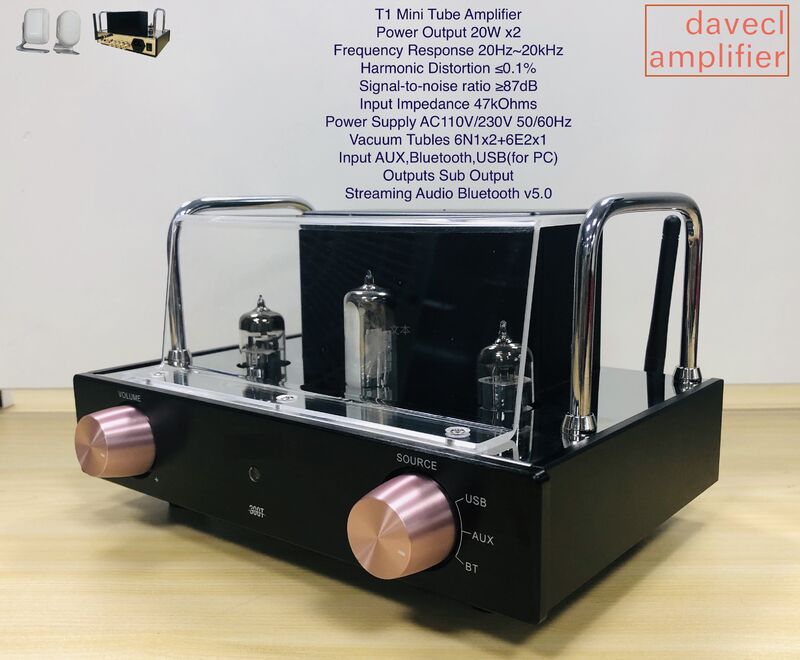
Simply share some knowledge about tube amplifiers
Tube amplifiers operate at high voltage and low current. The screen voltage of the final power amplifier tube can reach 400-500V or even thousands of volts, while the current flowing through the tube is only tens to hundreds of milliamperes. The input dynamic range is large and the conversion rate is fast.
Most tube amplifiers use discrete components, manual wiring, and welding, which are low-efficiency and high-cost. This is particularly evident in developed countries.
The open-loop performance of the tube power amplifier is better than that of the transistor. It does not need to add deep negative feedback and can work stably without adding a phase compensation capacitor, so its dynamic performance is better.
But in addition, the life of the electronic tube is relatively low, and some technical indicators drop significantly after one or two thousand hours of use. Tube amplifiers consume high power and often work in Class A status, which further reduces efficiency. However, there are basically no factors harmful to sound quality such as transient intermodulation distortion, switching distortion, and crossover distortion.
Tube amplifiers have no advantages over transistor amplifiers in terms of weight, efficiency, lifespan, and power consumption, and their disadvantages are all obvious.
Generally speaking, the sound quality of the tube amplifier is soft and pleasant. To be more specific, the low-frequency sound of the tube amplifier is soft and clear, and the high-frequency sound is delicate and clean. Expressing the human voice is its strong point.
In use, the electronic tube must have good ventilation and heat dissipation. Overheating will inevitably shorten the life of the electronic tube, so the temperature of the electronic tube should be kept as low as possible.
Electronic tubes are afraid of vibration, so it is also important to take anti-shock measures to avoid vibration as much as possible. If you do these two things, the service life of the electronic tube can be at least doubled!
For this reason, there should be appropriate space around the tube equipment, especially above it, to allow for good cross ventilation, and if possible, use fans to help dissipate heat.
When a high-voltage power supply is applied to the cathode of the electron tube before it reaches the required temperature, its cathode will be damaged and the life of the electron tube will also be shortened. Therefore, if the electronic tube equipment has a preheating device, it must be used!
For example, turn on the low-voltage power supply of the filament first to preheat, and then turn on the high-voltage power supply. If there is no preheating device, don't rush to connect the input signal. You can turn down the volume to the minimum and wait for 20 to 30 minutes to warm up the machine before using it.
If a side-heated rectifier tube is used to supply high voltage to the entire machine, it just provides a simple and effective high-voltage delay. In addition, during normal use, do not switch the power on and off frequently!
robinwang111
+86 18823794757
+86 18665912888 (whatApp/Wechat)
sales01@davecl.com
 Room 504, President Commercial Centre, 608 Nathan Road, Mongkok, Kowloon, HK
 No.196, Dongxing Road, Tangxia Town, Dongguan, GD, China Post code:523710