
Views: 0 Author: Site Editor Publish Time: 2026-09-05 Origin: Site


Confused by the endless sea of home theater terms? You are certainly not alone. Many beginners stare at a stack of electronic gear and cannot easily tell receivers and amplifiers apart. As you build your media room, a critical question arises. Do you really need to purchase extra, expensive gear? Or will your current equipment already do the job?
The short answer is highly encouraging: yes, absolutely. Every integrated unit inherently functions as an amplifier because it contains a built-in power stage. Whether you want to drive a simple stereo pair of bookshelf speakers or integrate a high-performance AV receiver for surround sound System, utilizing native amplification features saves money. It also dramatically elevates your listening experience. In this engineering-focused guide, we will break down exactly how these devices work and explore practical ways to optimize your audio setup.
Furthermore, recent market analysis reveals a massive shift in consumer audio trends. The demand for bulky, separate audio components is steadily shrinking. Instead, modern home theaters heavily favor highly integrated, smart receivers. Why? Advancements in high-efficiency power stages and advanced digital signal processing (DSP) mean today's receivers deliver massive, clean power without the severe thermal issues of the past. The industry is rapidly moving toward all-in-one centralized hubs that handle both high-resolution video and lossless audio simultaneously.
Key Takeaways
An AV receiver is a hybrid device. It combines a preamplifier, a digital audio/video processor, and a multi-channel power amplifier into one chassis.
You can use a standard receiver to drive passive speakers directly. No standalone amplification equipment is required.
Older receivers can be repurposed as dedicated external amps, provided they feature multi-channel analog inputs.
While pure audiophiles may prefer dedicated separates, an integrated unit offers unmatched convenience, easier wiring, and superior cost-effectiveness.
You can easily upgrade an existing home theater with an external amplifier if your receiver features dedicated "Pre-Out" connections.
To definitively answer how a receiver functions as an amplifier, we must break down the hardware architecture. Consumers often use these terms interchangeably. However, from an engineering perspective, they refer to entirely different internal designs. Grasping this distinction is the first step in building a reliable audio system.
A dedicated power amplifier is a highly specialized piece of equipment. It performs exactly one task. It takes a low-voltage audio signal (line-level) and boosts its electrical current enough to physically drive the heavy magnets inside passive speakers. A pure power amplifier contains no volume knobs. It has no video inputs, no radio tuners, and zero digital processing chips. Because it completely lacks a preamplifier stage, you cannot plug a smart TV directly into it. It relies entirely on a separate processor to handle source switching and volume control.
In contrast, an Audio/Video receiver acts as the centralized brain of your media room. Instead of being a single-function device, it is a multi-component hub. It seamlessly combines a preamplifier (handling your volume dial), a digital processor (decoding cinematic spatial audio formats), and a robust power amplifier (pushing the actual sound to the speakers).
To make the technical differences crystal clear, the core comparison table below outlines their functional capabilities:
Feature & Capability | Dedicated Power Amplifier | Standard AV Receiver |
|---|---|---|
Primary Function | Boosts audio signal power exclusively | Central hub for A/V processing and power |
Volume Control | No (Requires a separate preamp) | Yes (Built-in preamplifier) |
Video Processing (HDMI) | No | Yes (HDMI switching, high-res passthrough) |
Audio Decoding | No | Yes (Built-in DSP and internal DACs) |
Built-in Amplification | Yes (Massive, isolated power capacity) | Yes (Sufficient for most home theaters) |
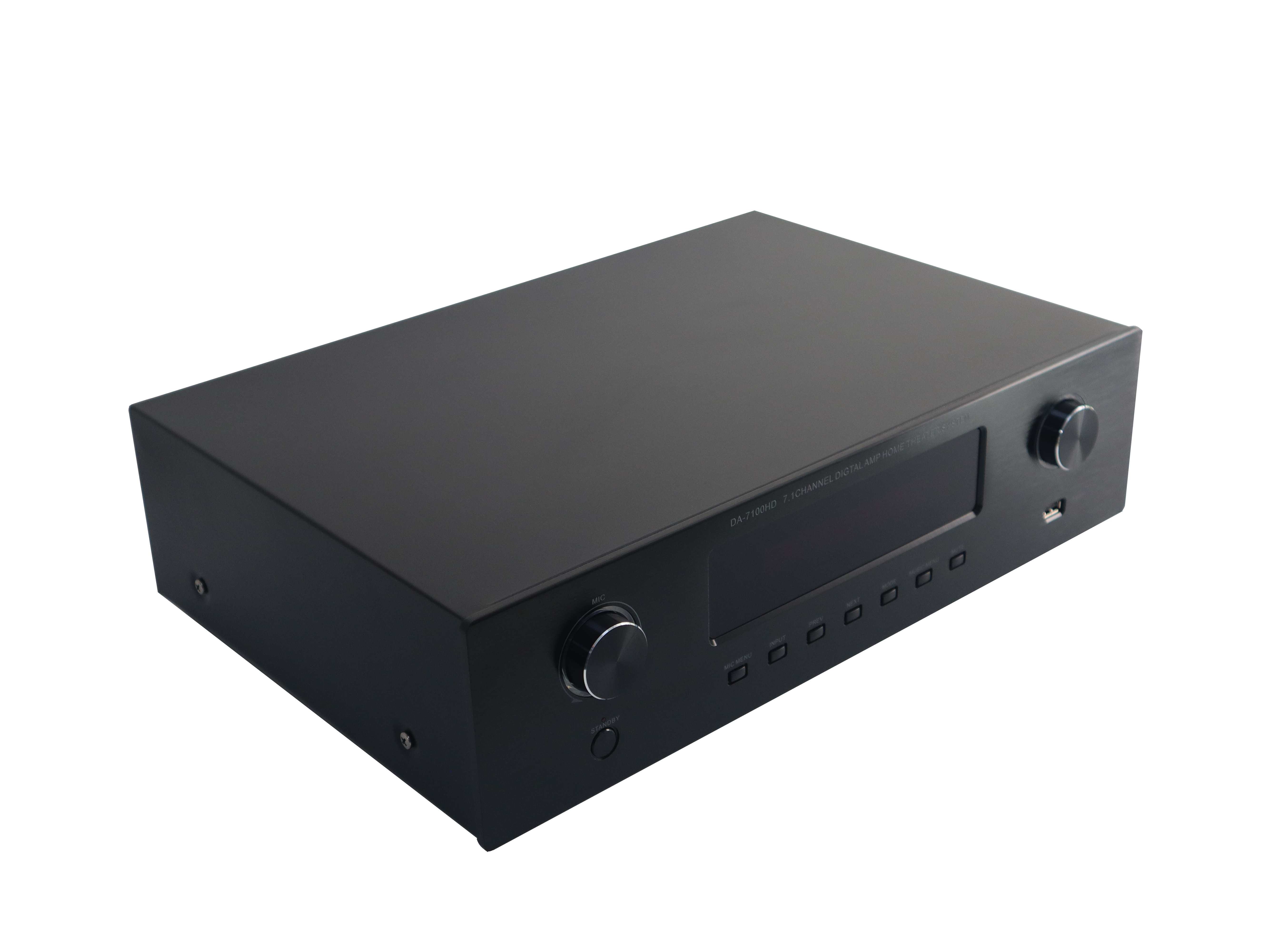
The direct answer to the core question is a resounding yes. Every AV receiver on the market packs a built-in power amplification stage right out of the box. You do not need to buy a separate amp to make your speakers roar. Place your hand over the top ventilation grilles of a working receiver. The heat you feel radiating upward is a direct byproduct of this internal amplifier hard at work.
Imagine plugging in a gaming console. The moment that digital audio signal travels through the HDMI cable, it follows a highly specific internal pathway. First, the digital data is translated into an analog waveform by the internal DAC (Digital-to-Analog Converter). Next, the preamplifier stage adjusts the voltage based on your master volume setting. Finally, this tailored signal routes directly into the internal power amplifier stage.
This internal amp is intelligently divided into multiple channels. In a standard setup, the receiver distributes power independently to the front, center, and surround speakers. Most modern consumer units deliver between 50 to 120 watts per channel (WPC) into an 8-ohm load. Empirical acoustic testing shows this wattage range easily drives standard bookshelf or tower speakers to cinematic volume levels.
A frequent scenario involves upgrading to a shiny new receiver to unlock modern video features, leaving an older unit sitting idle. Instead of discarding the heavy old equipment, resourceful audio enthusiasts often repurpose it strictly as a dedicated external power block. This adds more muscle to their new setup.
You certainly can repurpose an older unit. However, it requires a very specific hardware feature: multi-channel analog inputs. Take a look at the back panel. If you spot a cluster of RCA inputs labeled "Multi-Ch In", you are in luck. These specific inputs bypass the receiver's aging internal digital processing chips. They route the incoming analog signal directly to the robust amplification stage.
Conversely, if your old receiver only sports standard stereo RCA inputs (like AUX or CD), using it as a surround sound amplifier becomes highly impractical. Pushing a signal through standard inputs forces the audio through outdated DSP processing, which severely muddies the sound.
To successfully utilize an older receiver as a brute-force power amp, you must carefully configure the physical connections. This prevents a "double volume control" conflict.
Connect the RCA Cables: Run high-quality interconnect cables from the "Pre-Outs" of your modern receiver into the "Multi-Ch In" ports of the old unit.
Select the Correct Input: Power on the old receiver. Set its input source dial to "Multi-Channel" or "External In."
Set a Fixed Reference Volume: The old receiver still routes the signal through its analog volume circuitry. You must set its volume knob to a fixed, high level. A common industry standard is 0dB (on a relative display) or roughly 80% of its maximum limit.
Control the Master Volume: Never touch the old receiver's volume knob again. Use your new receiver to control the master volume of the entire bridged system.
For users who want to push their systems beyond standard limits, adding an external amplifier is a logical progression. While a standard receiver easily powers a conventional speaker system, highly demanding audio environments require robust power delivery. Connecting an external amplifier transforms your integrated unit into a dedicated preamplifier and processor.
To successfully bridge these two devices, your receiver must feature "Pre-Outs" (Preamplifier Outputs). These are analog audio outputs that transmit an unamplified, line-level signal directly from the internal processing stage to an external device.
When you plug an RCA cable from the receiver’s pre-out into a dedicated amplifier, the receiver gracefully stops amplifying that specific channel. Instead, it exclusively handles volume control and digital-to-analog conversion. The external amplifier receives this clean signal and applies its own massive power reserves. Entry-level receivers frequently omit pre-out connections to reduce costs. Therefore, always check your equipment specifications before attempting this upgrade.
The decision to integrate external power is usually driven by the need for better acoustic headroom and proper impedance matching. Most consumer units utilize a single, shared power supply transformer. If a receiver is marketed as "100 watts per channel," that measurement is often taken with only two channels driven. When a chaotic movie soundtrack demands simultaneous power across all channels, the actual output plummets. An external amp solves this bottleneck by providing isolated power reserves.
Furthermore, high-end loudspeakers frequently feature low electrical impedance, often dipping down to 4 ohms. Standard receivers are generally optimized for 8-ohm loads. When forced to deliver heavy electrical current to low-impedance speakers, they may overheat or trigger a protective shutdown. A dedicated power amplifier is engineered with massive heat sinks specifically designed to handle power-hungry speakers effortlessly.
When designing a home audio system from scratch, consumers face a critical crossroad. Should they purchase an all-in-one unit or invest in separate audio components? The optimal path depends entirely on your room size, budget, and wiring constraints.
From an engineering perspective, we recommend looking at hard specifications rather than marketing fluff. For instance, if you are evaluating a 7.1 AV receiver for surround sound System, you need concrete performance metrics. A professional-grade unit typically features a robust power supply delivering 100W to 120W RMS per channel into an 8-ohm load. It should include discrete high-current output stages, high-resolution video passthrough, and advanced room correction algorithms. Purchasing a separate processor and amplifier with equivalent smart features would easily cost three times as much.
Physical installation logistics also play a major role. Dedicated separate amplifiers are notoriously large, sometimes weighing over 70 pounds. They require open-air racks with active cooling fans. The wiring is highly complex. Conversely, a single integrated receiver simplifies cable management drastically. It consolidates all processing into a single chassis that fits inside standard TV stands. For users wanting a clean aesthetic without sacrificing cinematic audio quality, the integrated route is the undisputed optimal choice.
Wiring a home theater requires careful attention to detail. Because you are dealing with live electrical currents, making a connection error can result in permanent hardware failure. Avoid these critical engineering errors.
One of the most costly mistakes is ignoring speaker impedance (measured in ohms). Impedance is the electrical resistance your speakers present to the amplifier. A lower impedance allows more electrical current to flow.
Most mass-market receivers are explicitly designed for 8-ohm loads. If you connect power-hungry 4-ohm speakers to an entry-level receiver, they draw significantly more current than the internal components can handle. Imagine watching an intense action movie. Right during a massive explosion, the mismatch causes the receiver to overheat rapidly, triggering a thermal shutdown. Repeatedly triggering this protection mode will inevitably degrade the internal capacitors. Always verify that your receiver is stable at your speaker's specific ohm rating.
Another catastrophic error occurs when users connect two amplified devices improperly.
If you add an external amplifier, you must use the low-voltage RCA "Pre-Outs." Under no circumstances should you ever run standard speaker wire from the speaker outputs of a receiver directly into the RCA inputs of another amplifier. Speaker outputs carry a high-voltage, fully amplified signal. Feeding this massive electrical load into the delicate input stage of an external amp will instantly overload the circuitry and permanently fry the motherboard. Always differentiate between line-level signals and speaker-level signals.
Conclusion
At its core, an AV receiver is absolutely a highly capable amplifier. For the vast majority of users, it remains the most practical, efficient, and cost-effective way to power a modern home theater. While standalone amps hold their rightful place in extreme audiophile setups, investing in a high-quality AV receiver for surround sound System provides the ultimate balance. You get robust power delivery, cutting-edge digital processing, and everyday ease of use wrapped into one convenient chassis. Ready to build your dream media room? Explore the professional-grade audio solutions at Davecl to find the perfect equipment tailored to your specific acoustic needs.
No. Your receiver has a built-in amplification stage perfectly capable of powering standard passive speakers. Unless you are running highly specialized, low-impedance speakers in a massive custom theater room, the internal amplifier provides more than enough continuous wattage for a premium listening experience.
Yes. While designed with video processing in mind, they function flawlessly as standalone audio hubs. You can use it as a standard stereo amplifier to play high-resolution music via streaming platforms or analog inputs. Simply set the unit to "Stereo" mode to bypass the surround processing and enjoy pure two-channel audio.
Generally, no. A powered subwoofer already has its own internal amplifier built into the cabinet. You should connect it to the low-voltage "Subwoofer Pre-Out" (or LFE port) on your receiver using an RCA cable. Connecting a powered subwoofer to high-level speaker outputs can cause severe distortion or equipment damage.
Not in modern, well-engineered units. Historically, audio purists worried about internal electromagnetic interference between the video boards and the amplifier stage. However, today's high-quality receivers utilize shielded internal components, advanced DACs, and discrete power stages that deliver incredibly clean, distortion-free sound that rivals many separate amplifiers.
You must check the RMS (Root Mean Square) wattage and the impedance (Ohms) rating on both devices. Ensure the receiver's continuous output matches or slightly exceeds the speaker's recommended wattage range at the specified ohm level. Ignore "Peak" or "Dynamic" wattage numbers in marketing materials; RMS provides the only accurate measurement of reliable power delivery.
A stereo receiver is engineered strictly for two-channel audio (Left and Right). It typically lacks HDMI video inputs and digital audio decoders. An AV receiver is a multi-channel device that processes high-definition video signals and powers five or more channels to deliver immersive cinematic sound formats.


robinwang111
+86 18823794757
+86 18665912888 (whatApp/Wechat)
sales01@davecl.com
 Room 504, President Commercial Centre, 608 Nathan Road, Mongkok, Kowloon, HK
 No.196, Dongxing Road, Tangxia Town, Dongguan, GD, China Post code:523710