
Views: 0 Author: Site Editor Publish Time: 2026-09-08 Origin: Site


Building a high-performance home audio environment requires precise planning. Selecting the correct central command hub often becomes a technical bottleneck for many users. When mapping out an entertainment upgrade, system integrators and home theater builders face a classic hardware dilemma. Should you invest in a multi-channel AV receiver, or dedicate your budget to a traditional stereo amplifier?
Your final decision should rely heavily on signal processing requirements. Cinematic movie nights demand complex spatial audio decoding and video passthrough. In contrast, critical two-channel listening relies entirely on signal purity and acoustic precision. This guide breaks down the exact technical distinctions between these devices. We will analyze internal component allocation, address common hardware misconceptions, and provide a clear engineering perspective to help you choose the right equipment for your space.
AV Receivers function as robust, multi-channel processing hubs. They handle video switching, spatial audio decoding, and power delivery for complex multi-speaker arrays.
Stereo Amplifiers are highly focused, two-channel units. They are optimized strictly for high-fidelity music reproduction, purposefully omitting video circuitry to maintain an ultra-low noise floor.
The primary hardware differences lie in channel capacity, digital connectivity, power supply allocation, and DSP (Digital Signal Processing) capabilities.
Your purchasing strategy should align with your primary application. Prioritize receivers for immersive theater formats, or select amplifiers for uncolored analog audio playback.
Before diving into specific technical comparisons, we must establish clear functional definitions. Both devices act as the control center for your loudspeakers. However, their underlying engineering philosophies are fundamentally opposed.
An Audio/Video receiver operates as the digital processing brain of a modern home theater. Its primary directive is traffic management. It ingests mixed digital and analog signals from various source components—such as gaming consoles, Blu-ray players, and streaming devices. Once received, the internal DSP decodes spatial audio formats like Dolby Atmos. The unit then amplifies the signal to drive five or more speakers simultaneously, while seamlessly passing the high-resolution video signal to your display.
Conversely, a stereo amplifier serves a singular, focused purpose. It receives an audio signal, amplifies it with minimal distortion, and delivers it to exactly two speakers (Left and Right). Some modern integrated units include a dedicated subwoofer pre-out for a 2.1 configuration. Regardless, their core architecture is meticulously designed for uncolored sound reproduction. By stripping away video boards and complex digital switching, these units eliminate unnecessary electrical interference.
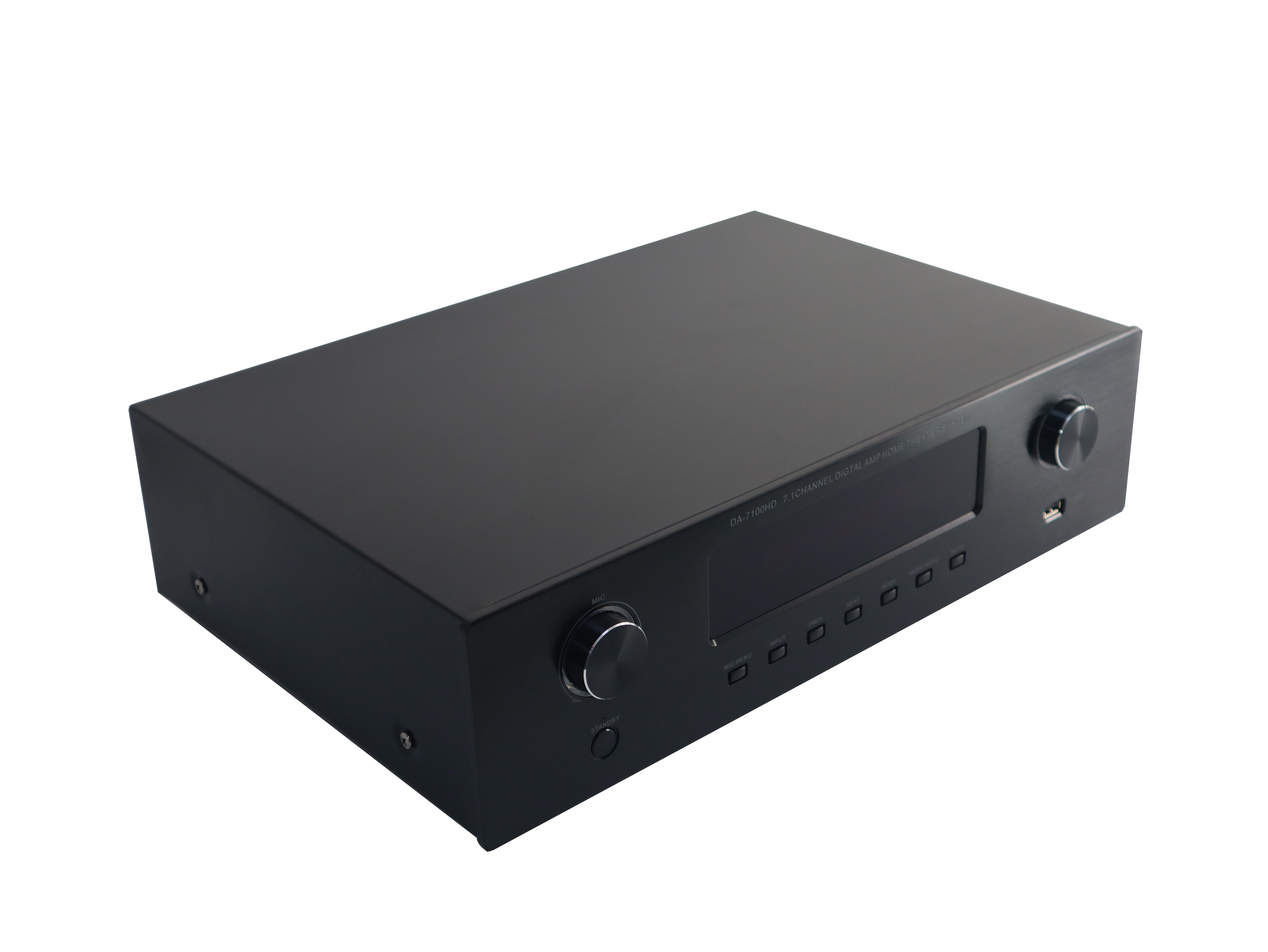
To make an informed specification, you must understand how these devices diverge at the circuit level. Below is a breakdown of their functional distinctions.
The most obvious physical difference is the speaker terminal layout. Stereo amplifiers are strictly built to power two channels. Multi-channel hubs, however, are engineered to decode directional soundscapes. They typically start at 5.1 channels and scale upwards. If your objective is an immersive acoustic environment, integrating a dedicated AV receiver for surround sound System is an absolute requirement. This ensures you have discrete power for a center dialogue channel, side surrounds, and low-frequency effects.
Modern media setups require heavy digital bandwidth management. AV receivers are equipped with advanced HDMI boards capable of 8K passthrough, HDR dynamic metadata handling, and eARC connectivity. This allows a single-cable solution to your television. Furthermore, receivers handle audio extraction from these video sources. Stereo amplifiers lack video inputs entirely, requiring you to route video directly to the display and send audio back via optical or analog cables.
This distinction highlights the "versatility versus purity" engineering tradeoff. At identical price points, a stereo amplifier generally delivers superior continuous power for music. Manufacturers dedicate the entire Bill of Materials (BOM) to massive toroidal transformers, high-capacitance power supplies, and isolated analog circuits. An AV receiver must stretch that same budget across video processing chips, HDMI licensing, DSP boards, and amplification for seven or more channels. Consequently, entry-level receivers may struggle with dynamic headroom when driving demanding, low-impedance speakers.
Feature | AV Receiver | Stereo Amplifier |
|---|---|---|
Audio Channels | 5.1 to 13.2+ | 2.0 or 2.1 |
Video Processing | Yes (HDMI, 4K/8K, HDR) | No |
Signal Purity | Good (DSP dependent) | Excellent (Low noise floor) |
Room Correction | Built-in automated software | Rarely included |
Primary Use Case | Home Theater & Gaming | Hi-Fi Music Listening |
Recent market data reveals a fascinating shift in the home audio sector. Historically, the boundary separating two-channel musical fidelity from multi-channel cinematic versatility was rigid. Today, consumer demand for hybrid functionality is actively reshaping hardware design. We are seeing a massive surge in spatial audio adoption for mainstream music streaming.
In response, manufacturers are equipping premium multi-channel hubs with audiophile-grade ESS Sabre DACs and robust, high-current amplification. This drastically improves their musicality. Specifically, the modern focus is shifting toward unified systems that handle both high-res audio and immersive theater formats without compromising signal integrity. The gap between a high-end receiver and a mid-tier stereo amp is rapidly closing.
If your primary source material includes high-bitrate streaming series, 4K Blu-rays, or visually demanding video games, a multi-channel hub is indispensable. The true value of modern cinema lies in object-based audio formats. These formats allow sound engineers to map precise audio metadata to specific locations in a three-dimensional room.
When specifying equipment for a medium-to-large living space, power delivery and decoding accuracy are paramount. A well-engineered 7.1 AV receiver for surround sound System serves as the ideal backbone. High-performance models provide extensive connectivity, featuring multiple HDMI inputs, optical/coaxial digital audio ports, and dedicated subwoofer outputs. More importantly, they maintain low Total Harmonic Distortion (THD) across all channels. This ensures dialogue remains highly intelligible while simultaneously driving the massive dynamic swings required for cinematic bass effects.
From an acoustic engineering perspective, spatial immersion is entirely different from absolute musical accuracy. Critical listening requires a system capable of rendering a precise "soundstage." This is the psychoacoustic phenomenon where the listener can pinpoint the exact physical location of instruments within the recording space.
Vinyl purists and high-resolution digital collectors prefer the unadulterated signal path of a dedicated amplifier. By physically omitting noisy video processing chips, engineers significantly reduce electromagnetic interference. This meticulous circuit design results in a strikingly low noise floor, tighter bass control, and the dynamic headroom necessary to drive inefficient tower speakers effortlessly.
To finalize your hardware specification, evaluate your project against these three practical criteria rather than relying on abstract user profiles.
Criteria 1: Space and Speaker Layout
Evaluate your physical room constraints. If you cannot properly place rear surrounds or ceiling speakers due to room geometry, installing a multi-channel receiver is inefficient. A high-quality stereo amplifier paired with premium bookshelf speakers will drastically outperform a poorly placed 5.1 system.
Criteria 2: Primary Source Material
Audit your daily media inputs. If 70% of your usage involves HDMI sources (Apple TV, PlayStation, Blu-ray), you require the digital switching and eARC capabilities of an AV receiver for surround sound System. If your primary sources are a turntable and a dedicated network streamer, prioritize the analog purity of a stereo amplifier.
Criteria 3: Future Expansion Requirements
Consider your upgrade path. If you are starting with two speakers but plan to add a center channel for better television dialogue next year, a receiver is the logical choice. It provides the necessary processing framework for future hardware additions.
When researching audio equipment, you will inevitably encounter subjective and outdated debates. It is critical to separate lingering myths from modern engineering facts.
Myth 1: Receivers fundamentally degrade music quality.
While an entry-level receiver might lack the warmth of a dedicated amp, the notion that receivers ruin music is obsolete. Modern premium receivers feature a "Pure Direct" mode. When engaged, this function bypasses video circuitry, DSP EQ, and digital displays. It effectively turns the receiver into a high-current, low-noise stereo amplifier during music playback.
Myth 2: Higher wattage specifications guarantee better sound.
Many buyers mistakenly purchase hardware based solely on the peak wattage printed on the box. In reality, continuous power delivery, high-current capability, and low THD matter significantly more than peak numbers. A meticulously engineered 60-watt stereo amplifier will routinely offer tighter bass control than a cheaply manufactured 120-watt multi-channel receiver.
Stereo amplifiers remain precision instruments. They are meticulously crafted to extract maximum fidelity from two-channel recordings, offering a pure signal path that audio professionals trust. On the other hand, multi-channel receivers are versatile powerhouses. They provide the complex digital processing and amplification necessary to transform a standard room into a three-dimensional acoustic environment.
Before finalizing your purchase, carefully audit your source components, room dimensions, and expansion goals. If you require advanced HDMI switching, automated room correction, and the ability to decode immersive object-based audio, investing in a robust AV receiver for surround sound System from Davecl is the definitive choice for your home theater project.
Yes, you can easily connect your television to a stereo amplifier via an optical cable or HDMI ARC (if supported by the amp). This configuration provides a massive acoustic upgrade over built-in television speakers, delivering excellent stereo separation. However, you will not experience decoded surround sound effects.
Absolutely. You can configure any modern receiver to run in a 2.0 or 2.1 layout. By utilizing the "Stereo" or "Pure Direct" listening modes, the unit disables spatial processing and height channels. This routes the audio signal cleanly through your front left and right speakers for a traditional listening experience.
At the exact same price point, a dedicated stereo amplifier generally offers a lower noise floor and better dynamic headroom. Its entire manufacturing budget is concentrated on perfecting two channels. Nevertheless, premium multi-channel receivers feature excellent DACs and robust power supplies that easily satisfy enthusiast listeners.
Stereo amplifiers often have a much longer usable lifespan, frequently lasting 15 to 20 years. Because they rely on standard analog technology, they rarely become obsolete. AV receivers, however, are tied to rapidly changing video standards (like HDMI versions and HDCP protocols). While the amplification remains solid, the video processing boards typically become outdated within 5 to 7 years.
If you are certain you will only ever utilize a two-speaker setup, a stereo amplifier is a more cost-effective and sonically accurate choice. That being said, if there is a strong possibility you will upgrade to a 5.1 layout in the future, purchasing a receiver now is a smart, future-proof investment.
An integrated AV receiver contains the processing brain, video switching, and internal power amplifiers required to drive the speakers in one chassis. An AV processor (Pre-Pro) handles all digital decoding and video routing but contains zero internal amplification. It must be paired with separate, dedicated multi-channel power amplifiers.


robinwang111
+86 18823794757
+86 18665912888 (whatApp/Wechat)
sales01@davecl.com
 Room 504, President Commercial Centre, 608 Nathan Road, Mongkok, Kowloon, HK
 No.196, Dongxing Road, Tangxia Town, Dongguan, GD, China Post code:523710