
Views: 0 Author: Site Editor Publish Time: 2026-09-25 Origin: Site


Vinyl records have reclaimed their rightful spot in dedicated listening spaces worldwide. However, navigating the analog audio market continues to confuse many prospective buyers. The motor architecture you choose dictates the foundation of your playback quality. In this comprehensive engineering guide, we will break down exactly how direct-drive mechanisms operate, analyze acoustic performance metrics, and help you determine if this technology aligns with your personal listening setup.
Before diving into the mechanical details and acoustic engineering, here is a quick summary of what you need to know about this drive technology:
Direct Mechanical Connection: The powerplant is located directly beneath the center of the platter. This completely eliminates the need for rubber transmission belts or intermediary pulleys.
Unmatched Speed Stability: Active quartz-locked speed control delivers instant start/stop times and incredibly accurate rotational speeds, ensuring perfect pitch during playback.
Long-Term Durability: Fewer moving parts mean zero consumable belts to wear out, stretch, or snap. These decks are famously low-maintenance.
Audiophile Approved: Modern engineering has eradicated historical motor noise issues. Today, this platform is a premium choice for critical home listening environments.
To truly appreciate how a record player impacts your daily listening experience, grasping its internal mechanics is essential. Direct-drive is exactly what it sounds like. The platter mounts straight onto the motor's spindle. There are no intermediary components transferring the kinetic energy. From an engineering standpoint, this architecture is brilliantly efficient.
In premium models, the platter itself actually functions as the rotor within the motor's magnetic field. The electromagnets sit on the base (the plinth), and the permanent magnets attach directly to the underside of the platter. When electricity is applied, magnetic forces push and pull. This causes the platter to rotate with immense authority and high torque.
Looking at broader industry trends, recent market analysis indicates a massive shift in consumer preferences toward direct-drive mechanisms within the home audio sector. While the early 2000s saw a dominance of minimalist belt-drive models marketed toward analog purists, current data reveals a soaring demand for high-torque, coreless systems. This pivot is largely driven by advancements in digital motor control. Modern vinyl collectors increasingly expect laboratory-grade precision without the hassle of constant mechanical tinkering. A modern direct-drive Hi-Fi turntable perfectly bridges this gap, combining broadcast reliability with refined acoustic materials to satisfy the most demanding audiophiles.
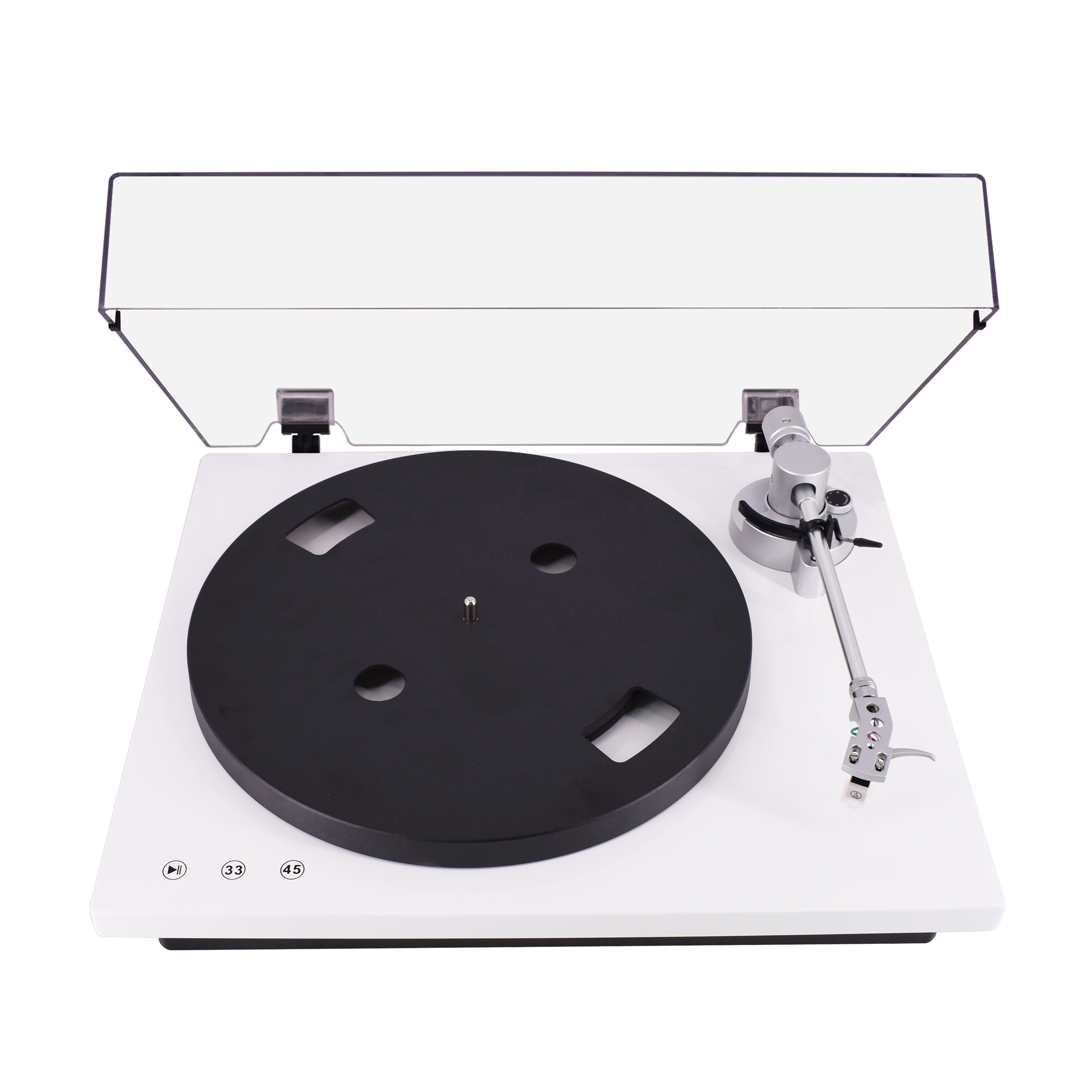
If you spend any time speaking with equipment dealers, you will quickly discover that the rivalry between belt-drive and direct-drive is hotly debated. Both engineering approaches have distinct philosophies regarding how to achieve optimal sound quality. To make an informed decision, we must look at the objective differences.
A belt-drive deck features a motor offset to the side, physically separated from the platter. A rubber belt acts as a transmission line and a shock absorber. While this provides excellent passive motor isolation, it sacrifices active speed control. Rubber stretches. Temperatures fluctuate. Belts degrade over time, leading to microscopic speed variations.
In contrast, direct-drive systems win unequivocally in active precision. Because the motor connects directly to the platter, the rotational force is significantly higher. To clearly illustrate the differences, consider the following technical comparison:
Feature / Metric | Direct-Drive Architecture | Belt-Drive Architecture |
|---|---|---|
Motor Placement | Directly beneath the platter spindle | Offset to the side of the plinth |
Speed Stability (Pitch) | Exceptional (Active quartz-locked control) | Variable (Relies on belt tension and condition) |
Torque & Responsiveness | Very High (Instant start and stop) | Low (Takes several seconds to reach speed) |
Maintenance Requirements | Extremely Low (No consumable drive parts) | Moderate (Requires periodic belt replacement) |
Primary Engineering Goal | Absolute rotational accuracy and durability | Passive acoustic isolation from motor vibrations |
When evaluating audio equipment, objective performance metrics are crucial. This specific architecture offers several measurable advantages that directly impact the fidelity of your vinyl playback.
Imagine dropping the needle on a pristine pressing of a Chopin nocturne. If a turntable struggles with pitch fluctuations, those lingering piano chords will sound seasick and warped. In analog audio, these variations are known as "wow and flutter." High-end direct-drive models utilize quartz-locked speed control to combat this. Similar to how a quartz watch keeps perfect time, an internal oscillator provides an exact timing reference to the motor. If the platter slows down even a fraction of a percent due to stylus drag in a heavy bass groove, the motor instantly compensates. This provides a rock-solid, pitch-perfect soundstage.
Furthermore, longevity is one of the most compelling commercial reasons to choose this technology. A direct-drive motor is a closed, highly efficient system. You do not need to hunt down specific replacement belts every few years. When you invest in a well-engineered HIFI turntable with direct drive, you are purchasing a mechanical centerpiece designed to run flawlessly for decades with minimal intervention.
To make an informed purchasing decision, it is essential to look at the technology objectively. While vastly superior in speed stability, engineers historically had to overcome specific acoustic challenges inherent to the design.
The most frequently cited historical disadvantage is "cogging." Traditional motors used iron cores surrounded by electromagnetic coils. As the platter rotated, the permanent magnets passed over these iron cores, creating a slight, stuttering magnetic pull. In cheaply manufactured models, this micro-stuttering translated into a low-frequency resonance that smeared audio detail.
However, modern engineering has systematically eliminated these issues. Premium high-end units today utilize "coreless" stators. By removing the iron core entirely, there is nothing for the magnets to "cog" against, resulting in buttery smooth rotation. Additionally, manufacturers now use incredibly heavy, resonance-deadening materials—like die-cast aluminum heavily damped with thick rubber—to absorb any residual motor vibration before it can ever reach the stylus.
When you transition from entry-level record players to audiophile-grade equipment, the purchasing criteria shift from basic functionality to precise engineering tolerances. A premium system is a significant investment. Here are the specific mechanical parameters you should verify:
First, explicitly look for specifications mentioning a "coreless DC motor" combined with "quartz-locked speed control." This combination guarantees absolute rotational accuracy regardless of stylus drag. A premium unit should boast a Wow and Flutter rating of less than 0.05%.
Next, evaluate the platter mass and damping. Because the motor is directly underneath, the platter must act as an acoustic shield. Avoid lightweight, hollow aluminum platters that ring like a bell. Instead, look for constrained-layer damping—platters constructed from die-cast aluminum coated with a thick layer of deadening rubber on the underside.
Finally, inspect the tonearm assembly. A high-torque motor requires a tonearm capable of tracking grooves with delicate precision. Prioritize rigid materials like carbon fiber or aircraft-grade aluminum. You must be able to calibrate the tracking force via a counterweight and adjust the anti-skate to counteract inward pull. Selecting a premium direct-drive turntable with these specific features ensures you are buying laboratory-grade hardware, not just marketing hype.
Navigating the high-end audio market requires separating empirical performance from aesthetic trends. For critical listeners seeking the absolute pinnacle of speed stability, durability, and sonic purity, transitioning to a meticulously engineered direct-drive system is the logical next step. It entirely eliminates the maintenance headaches associated with stretched rubber belts, offering a pristine, plug-and-play experience.
If you are ready to remove the mechanical limitations of traditional setups, we highly recommend exploring professional-grade equipment. By choosing a system that integrates a coreless motor architecture, a resonance-free heavy chassis, and a precision tonearm, you guarantee a flawless auditory journey. To experience the very best in vinyl playback quality, discover the meticulously engineered direct-drive Hi-Fi turntable solutions from Davecl, designed specifically to meet the rigorous demands of modern audiophiles.
From an objective, measurable standpoint, direct-drive turntables offer superior pitch stability. Because the motor is directly connected to the platter, the speed remains absolute. If you listen to music with long, sustained notes (like classical piano or ambient tracks), a direct-drive system will sound noticeably better because it prevents the slight pitch wavering that occurs when a rubber belt stretches. Modern premium units isolate the motor so effectively that their background silence matches or exceeds the most expensive belt-drive models on the market.
Yes, absolutely. While they were historically favored by DJs for their durability, modern advancements like coreless motors and heavy chassis damping have made them incredibly popular for home audiophiles. They offer laboratory-grade pitch accuracy, instant startup times, and require virtually zero mechanical maintenance, making them a highly convenient and premium choice for the living room.
One of the primary commercial benefits of this technology is the near-total lack of mechanical maintenance. Unlike belt-drive systems, which require you to purchase and install a new rubber belt every few years as the material degrades, a direct motor has no consumable drive parts. On a practical level, the only maintenance required is keeping the unit free of dust and occasionally applying a single drop of specialized synthetic oil to the main bearing spindle, depending on the manufacturer's specific guidelines.
Yes. Another major advantage of electronic motor control is the ability to change speeds instantly. Instead of manually moving a rubber belt to a different pulley (as required on many audiophile belt-drives), direct-drive systems allow you to switch between 33 1/3, 45, and sometimes 78 RPM with the simple push of a button. The quartz oscillator instantly adjusts and locks in the new rotational speed.
Mechanically speaking, the high torque makes it the only type of turntable capable of handling the physical stress of scratching and back-cueing without permanently damaging the motor. However, if you purchase a model specifically designated for High-Fidelity home listening, it will likely come pre-installed with a delicate audiophile cartridge (featuring an elliptical or Shibata stylus). These styli are engineered for deep groove tracking and will snap if you attempt to scratch with them. To DJ, you must swap the audiophile cartridge for a rugged DJ-specific cartridge with a spherical stylus.
Cogging is a mechanical stuttering effect found in older or cheaply manufactured motors containing an iron core. As the platter rotates, the magnets pull toward these iron poles in distinct "steps" rather than in one smooth motion. This micro-pulsing can transmit a subtle, low-frequency hum into the tonearm. You do not need to worry about this if you are purchasing a modern, premium unit. Today's high-fidelity manufacturers utilize "coreless" stator designs, completely removing the iron core from the equation and ensuring an absolutely silent background for your audio playback.


robinwang111
+86 18823794757
+86 18665912888 (whatApp/Wechat)
sales01@davecl.com
 Room 504, President Commercial Centre, 608 Nathan Road, Mongkok, Kowloon, HK
 No.196, Dongxing Road, Tangxia Town, Dongguan, GD, China Post code:523710