
Views: 0 Author: Site Editor Publish Time: 2026-09-17 Origin: Site


Imagine this scenario: You have just settled into your couch, ready to experience the latest blockbuster release. The climax approaches. The visual effects dazzle, but when the massive on-screen explosion hits, the sound falls flat. It lacks that visceral, chest-thumping impact you feel in a commercial cinema. Why does this happen? Standard all-in-one receivers often choke on complex, dynamic audio tracks. They simply run out of current, leaving you with a compressed, lifeless soundstage.
Dedicated audio separates solve this frustrating bottleneck. By dividing the electrical workload between a specialized preamplifier and a dedicated power amplifier, you unlock the true mechanical potential of your loudspeakers. In this engineering-focused guide, we will break down the functional differences between these components. More importantly, we will explain why upgrading your amplification is the definitive step toward achieving a reference-grade listening environment.
Separation of Duties: Preamplifiers handle delicate low-voltage signal processing and volume control. Power amplifiers provide the massive electrical current required to physically drive heavy speaker cones.
The Headroom Advantage: A robust amplifier delivers superior transient response. This ensures distortion-free audio reproduction during intense cinematic explosions or sudden musical strikes.
Immersive Audio Demands: For modern spatial formats like Dolby Atmos, high-channel-count amplifiers are practically mandatory to maintain consistent acoustic pressure across all surround zones.
Strategic Matching: Pairing a high-quality processor with a premium multi-channel amplifier transforms standard living room audio into a studio-grade acoustic space.
To make informed decisions about audio infrastructure, you must understand the functional division of labor within a signal chain. In entry-level consumer electronics, all audio tasks are crammed into a single chassis. High-fidelity audio, however, relies on "separates." This approach divides tasks among specialized, purpose-built components to eliminate cross-interference and maximize thermal efficiency.
Think of the preamplifier as the system's traffic controller. Its primary function is to accept signals from various source components—such as a streaming DAC, Blu-ray player, or turntable—and route them seamlessly.
Beyond source selection, the preamplifier performs a delicate electrical task: applying voltage gain. Source components output a very weak electrical signal, known as "line level." The preamplifier takes this fragile signal and boosts its voltage to a standardized level that a power amplifier can interpret. It also houses the volume attenuation circuit. Because it deals exclusively with low-voltage signals, a premium preamp relies on heavy internal shielding. This prevents electromagnetic interference (EMI) from nearby power supplies from polluting the audio path.
If the preamplifier is the brain, the power amplifier is the sheer muscle. It receives the refined, voltage-boosted signal from the preamplifier and applies massive current gain. Speakers are physical motors; they require significant electrical current to push and pull their magnetic voice coils against the resistance of air.
The power amplifier has a singularly brutal task. It must multiply the incoming signal with absolute linearity and deliver that raw power to the speakers. Unlike all-in-one receivers that share a single power supply across video boards and audio channels, a standalone power amplifier utilizes massive internal transformers and oversized capacitor banks. When a quiet violin solo instantly transitions into a roaring orchestra, this specialized architecture guarantees the amplifier can deliver sustained, clean current without voltage sag.
For enthusiasts upgrading from standard receivers, the financial investment in dedicated amplification requires hard justification. The benefits extend far beyond simply turning the dial louder. The real advantages lie in driver control, acoustic clarity, and hardware longevity.
A persistent myth in home audio is that high wattage is only necessary for deafening volume. In reality, upgrading your system drastically reduces distortion at all volumes. It provides a cleaner, highly detailed soundstage even during late-night, low-volume listening.
Amplifiers are graded by their Total Harmonic Distortion (THD) and damping factor. When an underpowered amplifier hits its operational ceiling, it distorts the waveform, adding harsh harmonics. By utilizing a high-capacity unit, you keep the equipment operating within its most efficient thermal and electrical range. The amplifier exerts a high damping factor—meaning it tightly controls the stopping motion of the speaker cone. Consequently, bass becomes tight and punchy rather than muddy, and dialogue remains crystal clear.
In audio engineering, "headroom" is the gap between the average operating level and the amplifier's maximum peak output. Cinema audio is highly dynamic. A whisper-quiet scene might be violently interrupted by a gunshot. These sudden sonic events, called transients, demand instantaneous bursts of electrical energy.
If an amplifier lacks headroom, it fails to supply the required current. This results in "clipping," where the amplifier physically chops off the peaks of the audio waveform. Clipping sounds harsh and generates destructive high-frequency energy that frequently blows tweeter voice coils. By integrating a high Power amplifier into your AV rack, you ensure transient peaks are reproduced with absolute authority and zero waveform distortion.
Not all loudspeakers present the same electrical load. Sensitivity and impedance dictate how hard an amplifier must work. High-end speakers often feature complex crossover networks that cause their impedance to dip down to 4 ohms—or even 2 ohms—at specific bass frequencies. This forces the amplifier to double its current output instantly.
A lightweight, budget amplifier will quickly overheat and trigger its protection relays under these conditions. Dedicated separates are specifically engineered with robust output stages to remain stable under punishing low-impedance loads.
Looking at the current trajectory of the home theater market, there is a definitive shift away from single-box solutions in premium setups. Industry data and search trends indicate a surging demand for multi-channel separates. This transition is heavily driven by the standardization of spatial audio formats like Dolby Atmos and DTS:X.
Previously, a 5.1 or 7.1 system could be adequately powered by a flagship receiver. Today, immersive audio requires a minimum of 11 discrete channels (7 ear-level, 4 height channels) to create a true 3D sound hemisphere. Consumers and custom integrators are realizing that packing 11 channels of amplification alongside dense digital video processing creates an insurmountable thermal bottleneck. As a result, the market is rapidly embracing high-efficiency, high-channel-count power amplifiers to offload the heavy lifting, ensuring no single channel is starved for power during demanding movie sequences.
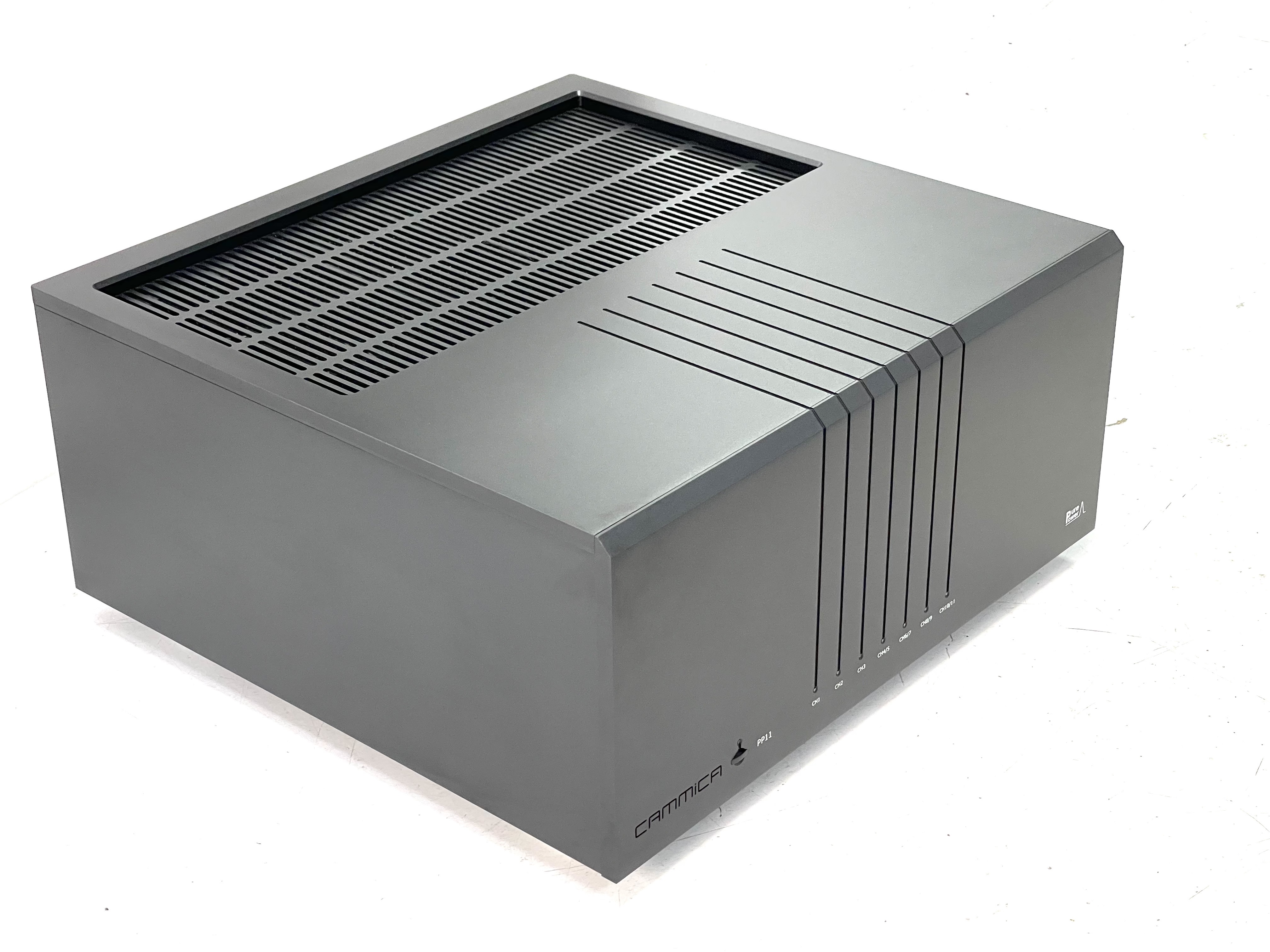
Choosing between an Audio/Video Receiver (AVR) and dedicated separates is the most critical architectural decision in home theater design. To understand why audio purists favor separates, we must look at the physical limitations of the hardware.
An AV receiver is undeniably convenient. However, this convenience dictates strict physical compromises. A standard AVR uses a single internal power supply to drive delicate DSP boards, HDMI switching, and multiple amplifier channels. If an AVR claims "100 watts per channel," read the fine print: that measurement is almost always taken with only two channels driven. When a movie demands power across all 11 channels simultaneously, the shared power supply collapses. The actual output per channel plummets, resulting in a collapsed soundstage.
Feature | Standard AV Receiver | Dedicated Separates (Preamp + Power Amp) |
|---|---|---|
Power Supply | Shared across video, audio, and all amp channels. | Isolated, massive dedicated power supplies for amplification. |
All-Channels Driven | Output drops significantly (often 50% or more). | Maintains near-peak wattage across all channels simultaneously. |
Thermal Management | Prone to overheating; cramped internal layout. | Optimized heat sinks; components breathe easily. |
Upgrade Path | Must replace the entire unit when HDMI/Video formats change. | Keep the amplifier for decades; only upgrade the processor. |
Furthermore, separates offer superior financial longevity. Digital video formats (like 8K or new HDMI standards) evolve rapidly, rendering the processing section of an AVR obsolete every few years. The physics of power amplification, conversely, remain static. A well-engineered amplifier will perform flawlessly for twenty years.
Evaluating power amplifiers requires looking past marketing jargon. You must focus on specific electrical specifications and design topologies to ensure a proper match for your speakers.
Ignore "peak" power ratings. You must look at continuous RMS (Root Mean Square) power, rated across the entire audible frequency spectrum (20Hz to 20kHz). More importantly, observe the amplifier's behavior when impedance drops. A truly robust amplifier will ideally double its wattage when the impedance halves from 8 ohms to 4 ohms, indicating a highly stable, high-current power supply.
Amplifiers are categorized by their circuit design. Class A provides exceptional linearity but runs incredibly hot, turning most energy into waste heat. Class AB has been the audiophile standard for decades, offering a great balance of fidelity and efficiency, though multi-channel variants require massive, heavy chassis. Recently, Class D (switching amplifiers) has revolutionized the industry. Modern high-end Class D modules run exceptionally cool and deliver staggering amounts of power from a relatively lightweight footprint, making them ideal for high-channel-count home theaters.
The interconnects between your preamp and power amp matter. Unbalanced RCA cables use two wires and are highly susceptible to picking up electrical hum over long runs. Balanced XLR connections utilize three wires and a clever phase-inversion technique (common-mode rejection) to actively cancel out induced noise. For premium setups, XLR inputs are highly recommended to achieve a dead-silent noise floor.
The advent of spatial audio fundamentally changed acoustic design. Standard 5.1 systems have been replaced by complex arrays that demand precise power management across every sonic zone in the room.
Formats like Dolby Atmos utilize object-based rendering. Sound engineers no longer assign audio to a static channel; they place an audio object in a 3D coordinate space. This requires a "bed" of ear-level speakers combined with multiple overhead ceiling speakers.
A benchmark premium configuration is 7.2.4 (seven bed speakers, two subwoofers, four height speakers). To execute this properly, every speaker must respond with identical dynamic authority. If an overhead helicopter pan sounds thin and weak compared to the front soundstage, your system is suffering from power starvation.
Powering an 11-channel setup with a patchwork of two-channel amplifiers leads to a cluttered rack, ground loop hums, and messy wiring. The most elegant engineering solution is to utilize a single, robust multi-channel chassis.
By investing in a dedicated 11-channel high Power amplifier for home theater, you consolidate your power requirements. Take, for example, the engineering behind the Davecl PP11. Units in this class are built with massive toroidal transformers and advanced circuitry designed to output hundreds of watts per channel into 4-ohm loads. This guarantees that your immersive audio formats perform exactly as the mixing engineer intended, delivering uniform, reference-level current to all 11 speakers simultaneously.
Transitioning to separates introduces new variables. Without careful planning, you can easily create system bottlenecks. Practical matching ensures your hardware performs at its absolute peak.
Pairing components requires electrical synergy. Specifically, you must ensure the preamplifier's output voltage is sufficient to drive the power amplifier to its maximum capacity. This is known as gain matching. If the preamp's output voltage is too low (e.g., 1V output into an amp requiring 2V for full power), you will never reach the system's dynamic potential. Conversely, an excessively high output can clip the amplifier's input stage.
In the practical realm of AV installation, thermal management is just as critical as wattage. High-capacity amplifiers generate substantial heat during heavy operation. Never stack a preamplifier directly on top of a power amplifier's ventilation chassis. Always leave at least three inches of vertical clearance for passive convection, or install thermostatically controlled cooling fans in your rack. Proper thermal management prevents protection-mode shutdowns and drastically extends capacitor lifespan.
To ensure your investment yields the highest possible fidelity, avoid these common, yet critical, installation errors.
One of the most frequent errors is buying amplification without analyzing the electrical characteristics of the loudspeakers. Measured in decibels (dB), sensitivity indicates how loud a speaker will play when fed exactly one watt of power, measured from one meter away.
Sensitivity operates on a logarithmic scale. Highly sensitive speakers (98 dB+) require very little wattage to reach cinematic volumes. Conversely, low-sensitivity speakers (85 dB or lower) are notoriously difficult to drive, demanding exponential increases in wattage. Relying on an underpowered unit for these demanding speakers results in a flat, compressed soundstage. Upgrading to a properly matched high Power amplifier ensures that regardless of individual sensitivity ratings, every speaker receives the precise current required to deliver uncompromised peaks.
A premium system is only as strong as its weakest electrical link. Because the preamp outputs a low-voltage signal, it is highly susceptible to EMI from nearby router antennas or power cords. Always route your audio interconnects away from AC power lines.
Secondly, high-output amplifiers draw massive amounts of alternating current (AC) from your wall. Plugging an 11-channel amplifier into a cheap, generic power strip chokes current delivery, artificially limiting the amplifier's dynamic range. Connect your separates directly to the wall receptacle, or use a high-current power conditioner on a dedicated 20-amp household circuit.
Upgrading your audio infrastructure takes careful planning, but the acoustic rewards are undeniable. Preamplifiers and power amplifiers work in perfect electrical harmony to elevate your listening experience from standard consumer audio to reference-grade fidelity. A robust, multi-channel amplifier provides the necessary muscle, ensuring clear, distortion-free audio for demanding cinematic soundtracks and high-resolution music alike.
This equipment forms the beating heart of your home theater. Ready to eliminate distortion and take your surround sound to the next level? Evaluate your room's requirements, check your speaker specifications, and explore professional-grade solutions. Find the perfect high Power amplifier at Davecl to permanently transform your listening space today.
Yes, a preamplifier is an absolute necessity. A power amplifier has a single, highly focused job: applying a fixed amount of gain to an incoming signal. It lacks a volume control knob and HDMI/audio input switching. If you connected a source directly to a power amplifier, it would immediately output the audio at maximum volume, instantly destroying your speakers. The preamplifier acts as the critical control center to decode formats and attenuate the volume safely.
An integrated amplifier combines both the preamplifier (volume control and input switching) and the power amplifier into a single chassis. While this saves space and money, it forces delicate low-voltage signal processing to share a box and power supply with high-current amplification stages, which can introduce noise. Separates isolate these two distinct functions into their own dedicated boxes with independent power supplies, resulting in a lower noise floor, better thermal management, and superior overall sound quality.
The exact wattage depends on your room's cubic volume, seating distance, and speaker sensitivity. However, as a general engineering baseline for a high-fidelity theater, providing 100 to 200 watts of continuous RMS power per channel (rated at 8 ohms, all channels driven) is optimal. This ensures the system possesses the necessary headroom to render dynamic peaks with effortless precision.
Absolutely. Bass frequencies require the most electrical current to reproduce because low-frequency drivers (woofers) are heavy and move a lot of air. A dedicated power amplifier has a massive power supply and a high damping factor, meaning it can start and stop the woofer cone with extreme precision. This eliminates "boomy" or muddy bass, replacing it with tight, articulate, and punchy low-frequency impacts.
Yes, provided your AV receiver is equipped with "pre-outs" (preamplifier outputs). These analog connections bypass the receiver's internal amplifiers. By connecting an external power amp, your AVR effectively becomes a dedicated processor. This hybrid approach offloads the heavy lifting from the receiver's internal power supply, instantly upgrading your system's dynamic headroom and thermal stability.


robinwang111
+86 18823794757
+86 18665912888 (whatApp/Wechat)
sales01@davecl.com
 Room 504, President Commercial Centre, 608 Nathan Road, Mongkok, Kowloon, HK
 No.196, Dongxing Road, Tangxia Town, Dongguan, GD, China Post code:523710